
Otaru Group Study for Teachers | Operations Checklist
・
When you run group study in Otaru on a school trip, it helps to decide four things first on the teachers' side: the meeting place, coach waiting, emergency contacts and the return time for groups on foot. This guide is an operations checklist for accompanying teachers. It assumes groups of 4 to 6 junior or senior high school students moving only on foot, with 2 to 5 hours of free time.
Contact details, fees and opening hours can change. The information here was checked against official pages on November 7, 2026, but please confirm it with your school, the bus company and each facility before the day.
Key points
- Plan for groups to start back toward the station 30 minutes before the meeting and to be near the meeting place 15 minutes before
- For coaches, confirm Sakaimachi Tourist Bus Parking (40 spaces, ¥2,000 for up to 24 hours) and others with the bus company
- Pick a meeting place you can explain with a photo: the station front, the Chuo Bus terminal or the canal
- Have students report problems to the teacher first, and call 119 or 110 when life or safety is at risk
The short answer: design the day so groups head back toward the station 30 minutes early
Otaru's sights cluster around JR Otaru Station, the Otaru Canal and Sakaimachi Street. Give students some freedom, but set a common rule on the teachers' side: "start heading back toward the station 30 minutes before the meeting" and "be near the meeting place 15 minutes before." That absorbs delays from shopping, toilet stops and students who feel unwell.
- Start heading back30 min beforeToward the station
- Be near the meeting place15 min beforePreliminary roll call
- Emergencies119 / 110Life and safety first
| What to decide | Teachers' standard |
|---|---|
| Meeting place | Somewhere you can explain with a photo: the station front, the Chuo Bus terminal or the canal |
| Time to start back | Tell students 30 to 45 minutes before the meeting |
| Group range | Around the canal and Sakaimachi Street, reachable on foot back to the station |
| Emergencies | Students contact a teacher first; call 119 for severe symptoms or accidents and 110 for crimes or traffic accidents |
| COTARU | One place that can serve for a cafe break or for adjusting time before the meeting |
For a sample itinerary for students, see the Otaru group study model course, and for photo tips and rules, see 15 photo spots for school trips in Otaru. Keeping the pre-trip briefings separate from this guide makes them shorter.
Preparation: keep group cards and the teachers' ledger separate
To reduce confusion on the day, keep the group card that students carry apart from the ledger that teachers hold. The group card holds only the minimum students need to act on; the teachers' ledger is for management and includes contact numbers, medical conditions and anything needing special care.
| Type | What to include |
|---|---|
| Student group card | Group number, member names, meeting place, meeting time, the teacher's emergency number, time to start back |
| Teachers' ledger | Roster by group, mobile numbers, special needs, medicine and allergies, coach number, hotel contact |
| Shared with the bus company | Pickup point, drop-off point, whether waiting is allowed, arrival time, the lead teacher's phone number |
| Headquarters memo | 110 and 119, after-hours medical contact, nearest police station, tourist information center, rainy-day meeting place |
On the group card, rather than how to use a map app, write in large letters: "If you have trouble, stay put and contact your teacher," "If you cannot reach a teacher, ask a nearby adult or facility staff," and "Call 119 for sudden illness or injury, 110 for crimes or traffic accidents." Reducing what students must decide on their own is what matters when groups move on foot.
Coach parking and drop-off points
Otaru City publishes a tourist bus parking map covering central Otaru, with names, capacity, hours and locations. Do not decide coach waiting or drop-off on the school side alone; confirm it with the bus company and Otaru City's latest information.
| Parking | Hours | Capacity | Fee | Notes |
|---|---|---|---|---|
| Sakaimachi Tourist Bus Parking (7 Minatomachi, city-run) | 24 hours | 40 vehicles (11 or more seats) | Flat ¥2,000 for up to 24 hours | Operated by Kyowa Sogo Kanri (0134-27-2233) |
| Cruise Terminal Bus Parking (trial) | 9:00 to 17:00 | Up to 28 vehicles (fewer in winter) | Free | Trial from April 10, 2026 to March 31, 2027. Not available on cruise ship call days |
Call days and available days at the Cruise Terminal Bus Parking change. Confirm them in advance through your travel agency or the bus company. The contact is the Otaru City Port Office (0134-32-4111, ext. 7386).
For cars and scouting vehicles, our Otaru parking guide compares rates and hours. Places that can take large vehicles are limited, so check the official pages first.
Meeting places: think in three types, station, bus terminal and canal
Choose a meeting place you can explain with a photo. The station front is an easy landmark for trains and buses, and the Chuo Bus terminal has a waiting room and toilets, so it is a good candidate for regrouping in bad weather. The canal area is convenient near the sights, but groups are hard to find when it is crowded. Also consider having group leaders contact a teacher before the meeting.
The Chuo Bus Otaru Station Terminal is at 2-22-10 Inaho, Otaru, and has an information desk, a waiting room, a kiosk and toilets. The ticket window is open 7:30 to 18:00 Monday to Friday and 7:30 to 17:00 on weekends and holidays (Otaru Tourism Association). The phone number is 0134-25-3333.
Inside JR Otaru Station there is a tourist information center, open 9:00 to 18:00 (hours may change with the season) with no regular holidays (Otaru City). The station coin lockers come in small (¥400), medium (¥500) and large (¥700 and ¥800) sizes and can be used for up to 3 days counting the first day (JR Hokkaido). Moving as a group while carrying large bags raises the risk of delays and falls, so decide how to store bags together with your school itinerary. Check availability at the station on the day.
Walking-only range, and exceptions that are easy to forbid
This guide designs group study for junior and senior high school students on foot only. Rental bicycles are an option for ordinary tourists, but for student groups they add things to check, such as traffic rules, helmets, insurance, slopes, riding in formation and where to park, so we do not recommend them here.
| Judgment | Treatment in operations |
|---|---|
| Within walking range | Otaru Station, the canal, Sakaimachi Street, the Märchen Intersection |
| Conditional | The former Temiya Line (about 15 minutes on foot from the station), the Minami-Otaru side, places with slopes or steps such as Suitengu |
| Excluded in principle | Tenguyama, Shukutsu, Otaru Aquarium, the Asarigawa area and other places that are hard to walk back from |
| Not recommended | Rental bicycles for student groups |
- Otaru StationMeeting and departure
- Walk, about 8 to 10 min
- Otaru Canal (Asakusabashi Plaza)Tourist information center on site
- Walk, about 5 min
- Sakaimachi StreetShopping and streetscape
Simplified diagram, not a map (distances are not to scale)
The canal is an 8 to 10 minute walk from Otaru Station (Otaru City says 8 and the Otaru Tourism Association says about 10), and Sakaimachi Street is about 5 minutes on foot from the canal (according to the shopping street). Have students judge not by "can we get there?" but by "can we all be back 30 minutes before the meeting?" and the range narrows naturally. For groups that want to see many places, tell them to cut out just the center, the station, canal and Sakaimachi, for a walking route.
Emergency contacts: funnel to teachers, but never hesitate over 110 and 119
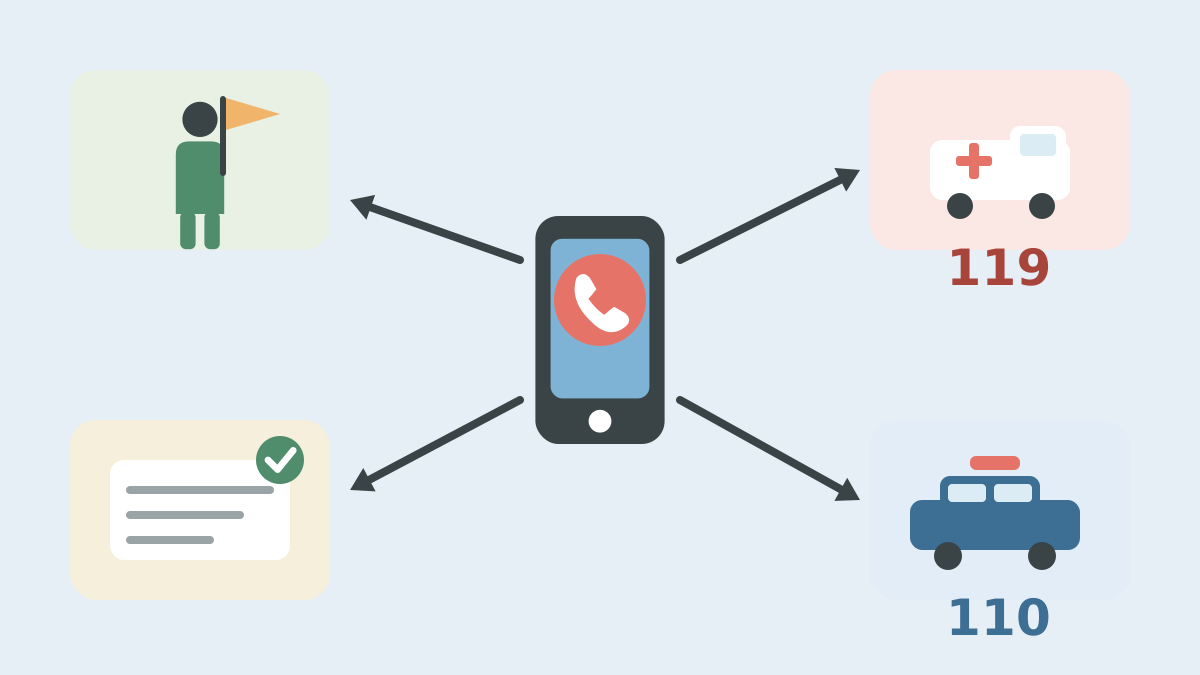
Accidents, sudden illness, getting lost, a lost wallet or a dead smartphone battery are the troubles most likely to occur during group study. Rather than asking students for fine judgments, share a rule beforehand: minor troubles go to a teacher, and when life or safety is at risk, 119 and 110 come first.
| Contact | For | Hours and place |
|---|---|---|
| 119 | Sudden illness, injury, fire | Severe symptoms, such as a sudden severe chest pain |
| 110 | Crimes, traffic accidents | Otaru Police Station is at 1-7-1 Tomioka, Otaru, tel. 0134-27-0110 |
| Otaru After-Hours Urgent Care Center | Illness at night or on holidays | 1-7-16 Suminoe, Otaru, tel. 0134-22-4618 (Japanese only; interpretation by tablet inside). 18:00 to 7:00 on weekdays, Sundays and holidays; 14:00 on Saturday to 9:00 on Sunday. On Sunday and holiday daytimes (9:00 to 17:00), an on-duty doctor handles cases |
| Chuo Bus terminal | Bus information | 0134-25-3333 |
Otaru Fire Department's guide to calling 119 correctly says to speak calmly, slowly and clearly and to answer the questions to the end. You will be asked whether it is a fire or an emergency, the location (if you do not know the address, nearby building numbers, large buildings, traffic lights or bus stops), who is hurt and how, and your name and phone number. For a medical emergency, give the person's age and sex, how serious the injury is and whether they are conscious. It helps to have students practice, before departure, telling the dispatcher where they are, what happened, how the injured person is and a nearby landmark.
This image was generated by AI for illustrative purposes.
First response to illness, getting lost, lateness and rain
As a rule, keep the whole group where it is when a student feels unwell. Moving only the student who feels ill throws off who contacts whom, who stays and where the teacher is heading. Choose a place for the teacher to go to that is easy to explain, such as the station, the bus terminal or near the canal.
| Case | First response | Teacher's decision |
|---|---|---|
| Feeling unwell | Move into shade or indoors and have the whole group contact the teacher | The teacher goes to the spot or guides them to a nearby meeting place |
| Lost | Keep the group still and have them send a photo of where they are or the names of nearby facilities | A nearby teacher goes to collect them |
| Likely to be late | Have them report the time they started back and where they are | Share with the roll-call teacher at the meeting place |
| Lost items | Set a time limit for searching and put the meeting first | Teachers decide whether to contact the police, a facility or the bus company |
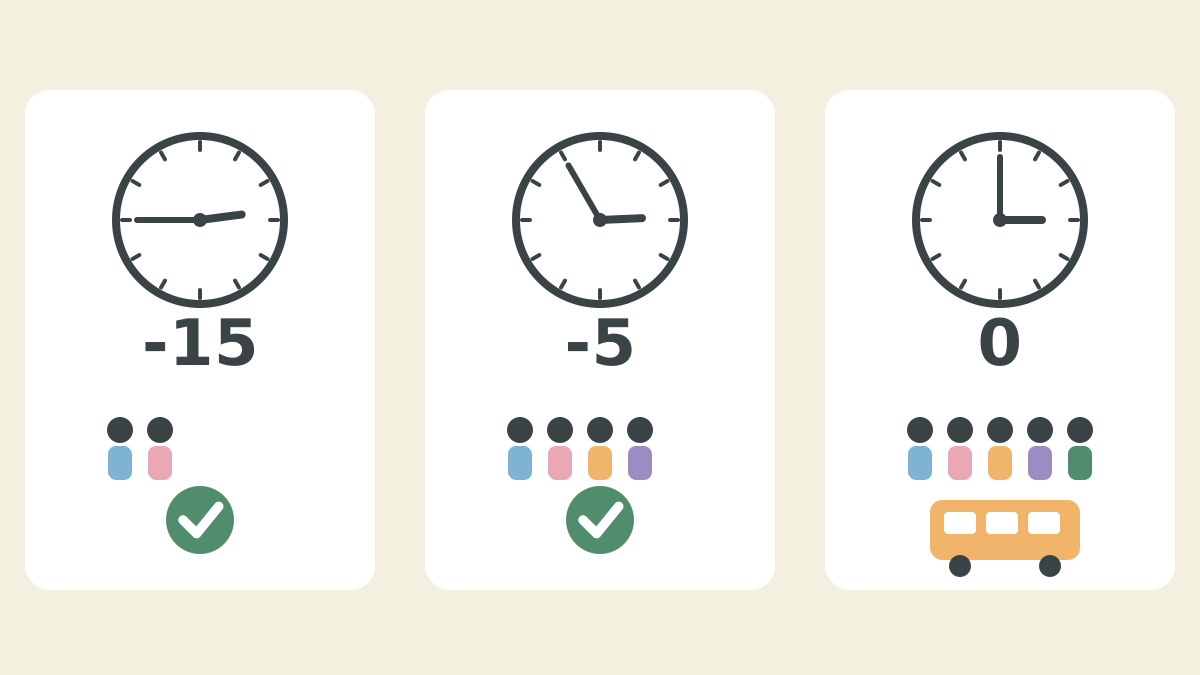
Rather than starting roll call exactly at the meeting time, use three stages: a preliminary roll call 15 minutes before, a final one 5 minutes before, and a bus-by-bus count just before departure. If a group is late, split the teachers into those who leave the meeting point and those who stay.
This image was generated by AI for illustrative purposes.
On rainy or crowded days, shorten long stays at the canal and switch to staying indoors in Sakaimachi Street and waiting around the station. On crowded days groups tend to bunch up around the Märchen Intersection and Asakusabashi, so set a time limit for photos in advance.
| Situation | Change |
|---|---|
| Rain | Shorten outdoor photography and move the meeting place closer to the station or bus terminal |
| Strong wind | Avoid long waits along the canal |
| Hot | Put drinks, shade and a cafe break first |
| Cold | Keep outdoor roll calls short and adjust with a waiting room or a cafe break |
| Crowds | Have group leaders report their location and head back 30 minutes before the meeting |
COTARU (3-1-1 Inaho, Otaru) is about a 5-minute walk from Otaru Station and is one place that can be used for a cafe break or to adjust time before the meeting. Check the shop's own information for hours and group visits.
Map
FAQ
Where is a good meeting place for group study?
Somewhere you can explain with a photo, such as the front of Otaru Station, the Chuo Bus terminal or the canal (Asakusabashi Plaza). The Chuo Bus terminal has a waiting room and toilets, which makes it easy to regroup in bad weather.
Where can tourist coaches park?
The city-run Sakaimachi Tourist Bus Parking (7 Minatomachi) is open 24 hours, holds 40 vehicles and charges a flat ¥2,000 for up to 24 hours. There is also the Cruise Terminal Bus Parking, a trial facility. Confirm the latest information with the bus company and Otaru City.
Whom do we contact if a student becomes ill at night or on a holiday?
Call 119 for severe symptoms or loss of consciousness. The Otaru After-Hours Urgent Care Center (0134-22-4618) takes patients from 18:00 to 7:00 on weekdays, Sundays and holidays, and from 14:00 on Saturday until 9:00 on Sunday. On Sunday and holiday daytimes, an on-duty doctor handles cases.
When should we take roll call?
Three stages work well: a preliminary roll call 15 minutes before the meeting, a final one 5 minutes before, and a bus-by-bus count just before departure. If a group is late, split the teachers into those who leave the meeting point and those who stay.
How should we change the plan on a rainy day?
Shorten outdoor photography and move the meeting place closer to the station or bus terminal. Have group leaders report their location and tell them to start back 30 minutes before the meeting.
Summary: set the return time and the contact rules first
Group study in Otaru runs more steadily once you fix a common rule in advance: head back toward the station 30 minutes before the meeting and be near the meeting place 15 minutes before. Check coach waiting places and emergency contacts with the bus company and the latest official information.
Tell students that if they have trouble they go to a teacher first, and that when life or safety is at risk 119 and 110 come first. Plans often change on the day with rain and crowds, so have students decide not by "can we get there?" but by "can we all get back?"