Otaru Bicycle Parking Guide 2026 | Where to Park at the Canal, Sakaimachi and the Station
・
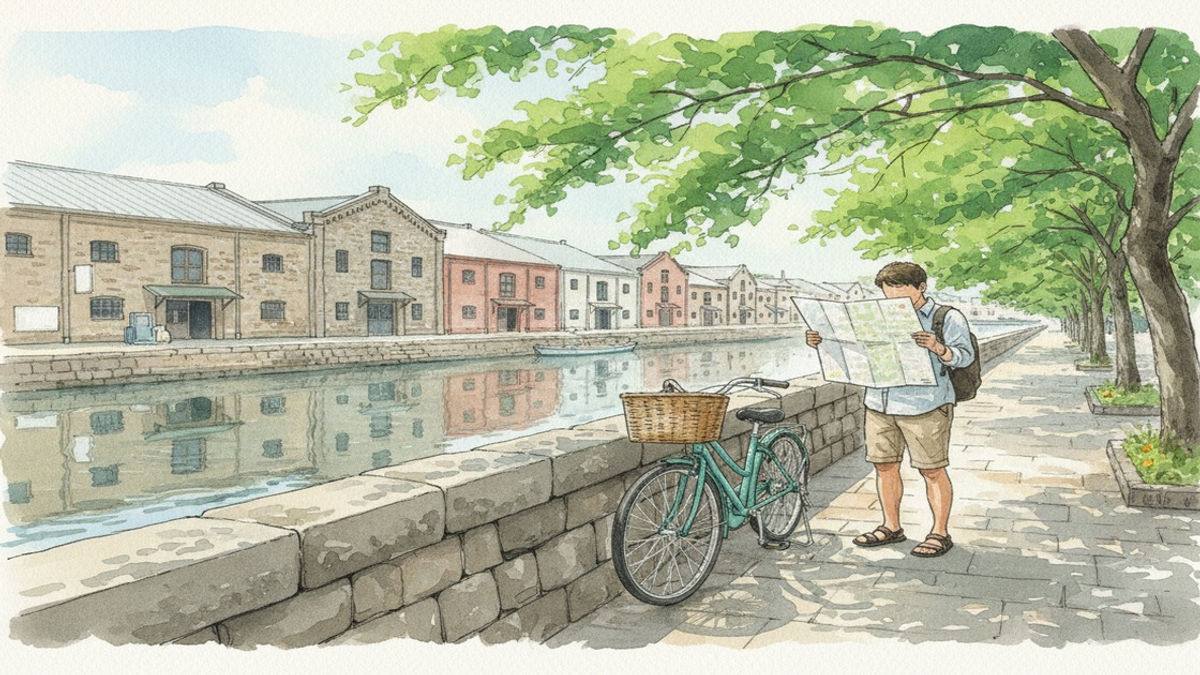
When you explore Otaru by rental bicycle, one thing that's surprisingly confusing is "where to park". There are few dedicated bicycle parking areas in the sightseeing areas, which can be hard to figure out on your first visit. But if you know each area's rules in advance, you can sightsee with peace of mind. This article covers specific places to park at the canal, on Sakaimachi Street and around the station, plus theft prevention, what to do in the rain and the new rules for 2026.
The short answer: in Otaru, "when to get off" matters more than "where to park"
Splitting Otaru's main sightseeing areas into four makes it clear how to use and park your bicycle. Use the table below as a guide before you set off.
| Area | How to use your bicycle | Parking basics |
|---|---|---|
| Otaru Canal (Asakusa Bridge, Chuo Bridge) | Pedestrians have priority around photo spots | Park in the Canal Museum courtyard or in front of Canal Plaza and walk |
| Sakaimachi Street | Walk your bicycle when it's busy | Park before the street and shop on foot |
| Former Temiya Line | Treat the path as a place for walking | Get off and walk a short way |
| Around Otaru Station | Base for starting and returning | Use the city space or paid bicycle parking |
There aren't many dedicated bicycle parking areas, but there are definitely places to park. The specific spots in each area are explained below.
Parking in the canal area: Chuo Bridge, Asakusa Bridge and the Canal Museum
The canal area is Otaru's main sightseeing spot. There are many pedestrians, and the flow of people around Chuo Bridge and Asakusa Bridge is constant, especially during the day.
The courtyard of the Canal Museum (Otaru Museum Canal Building) is the safest place to park. If you ask at the reception desk, you can park in the courtyard. It's surrounded by buildings, so it works in the rain too, and the staff of nearby facilities can keep an eye on it. Another advantage is that it's easy to find when you come back from a walk along the canal.
If you don't plan to visit the Canal Museum, the space around the facilities in front of Canal Plaza is an alternative. "Park in front of a facility where you won't be in the way" is the basic rule throughout Otaru's sightseeing areas, and it applies here too.
Asakusa Bridge Park is a famous photo spot, but there's no dedicated bicycle rack. Realistically, park a little before it and walk to the bridge. The bridge gets crowded with tourists taking photos, so wheeling a bicycle onto it is dangerous.
There's a cruise boarding area around Chuo Bridge, and it gets crowded especially from morning to midday. It's smoother not to ride too close, and to park a little away and walk.
The North Canal area has fewer tourists than Asakusa Bridge and is more relaxed. However, there's no dedicated bicycle parking, and the area in front of the stone warehouses is a pedestrian zone. You'll need to judge for yourself where to park "in front of a facility where you won't be in the way".
Parking on Sakaimachi Street: around Kitaichi Glass, LeTAO and the Music Box Museum
Sakaimachi Street is Otaru's top shopping street, lined with sweets, glassware and souvenir shops. Because there are so many reasons to stop, the basic rule is to park before the street and switch to walking.
There's no dedicated bicycle parking along the street. Kitaichi Glass has two paid car parks (along Sakaimachi Street, 8:30–20:30, ¥400 per hour), but they aren't presented as bicycle parking. If you stop by, the surest thing is to ask the staff. There are no bicycle racks in front of the Music Box Museum or LeTAO either, so you'll need to park along the road where you won't be in the way.
The path along the former Temiya Line is narrow and not suited to riding. We recommend getting off, walking your bicycle and enjoying the photo opportunities as you go.
After a big shopping trip, you'll have more bags. If you have more than fits in your bicycle basket, you may need to go back to the rental shop to leave them and then set off again. Thinking before you leave about "how much shopping you're likely to do" makes it easier to plan your return time.
Detailed walking routes around the former Temiya Line and Sakaimachi are introduced in our Otaru Rental Bicycle Half-Day Course.
Bicycle parking around Otaru Station: city-run, private and paid options
The area around Otaru Station works as the starting and finishing point for sightseeing. Many people start from a nearby rental bicycle shop, so let's sort out the parking options.
Refer to the table below. We recommend checking the latest information on site for whether the city-run spaces in front of the station are paid or free.
| Facility | Address | Price | Notes |
|---|---|---|---|
| North side of Otaru Station Plaza (city-run) | Inaho area | Check official site | About 150 bicycles, no racks, closed in winter |
| Paraca Otaru-shi Ironai No. 2 | 1-2 Ironai | ¥100 per 60 min, max ¥500 per 24 hours | 9 min walk from the station; reservation system |
| Port Authority sightseeing car park | 4-2 Minatomachi | Motorbikes ¥200 per visit | April–November 7:00–20:00 |
The city-run space on the north side of the station plaza is a flat area without racks, and it's closed in winter for snow. It may be free to use, but its official management is*.
Paraca Otaru-shi Ironai No. 2 is a paid facility with reservations, an option when you want to be sure of a space. It's a 9-minute walk from the station, a bit far, but the price is kept low at a maximum of ¥500 per 24 hours.
COTARU's starting point (3-1-1 Inaho, about a 5-minute walk from the station) is on Chuo-dori. Before you set off, you can ask the staff about routes and luggage. Our Otaru Rental Bicycle Comparison of 3 Shops summarizes each operator's location, prices and features.
Locks and theft prevention: parking your rental bicycle safely
Locking is essential when you park. Rental bicycles have a built-in fixed lock (ring lock / horseshoe lock). It locks the wheel so the bicycle can't be moved, and is effective for short stops.
The Hokkaido Police recommend double locking, combining a wire lock and a ring lock. Tourist areas in particular see a lot of short-term parking, and bicycle theft is said to account for about 20% of criminal offenses. Even for a short time, the risk isn't zero.
Ideally, lock your bicycle to a fixed object such as a fence or bicycle rack. Make it a habit to "always use at least the built-in lock where there's nothing fixed to lock to".
Crime prevention registration is mandatory if you own a bicycle. The fee is ¥800 (in Hokkaido), and the data is kept for 10 years. Rental bicycles are already registered by the operator, so you don't need to do anything extra.
If your bicycle is stolen, report it to Otaru Police Station (1-7-1 Tomioka, 0134-23-0110). Carry valuables with you as much as possible, and avoid leaving them in the basket for long periods.
Parking and what to do in rain or bad weather
On rainy days, parking starts with checking "is there a roof?". There aren't many roofed bicycle parking areas in the sightseeing areas, so it's reassuring to decide on candidates in advance.
Roofed places you can use include the sheltered pick-up area at JR Otaru Station Plaza and the covered part of the bus terminal. The area under the roof on the station side is also used for brief stops and boarding, so please avoid occupying it for long.
The Canal Museum courtyard is surrounded by buildings and feels almost indoors, so you can park there with relative peace of mind even in the rain. You do need to ask at reception, though.
Kitarin does not rent bicycles on rainy or windy days. On days with unsettled weather, check its official social media that morning for its operating status.
During the snow season (roughly December to March), rental bicycle operators themselves close. When planning your trip, check their operating periods in advance. Alternatives on rainy days are walking, buses and taxis. Waiting for the weather to clear while passing time in cafés and indoor facilities is also an option.
New rules in 2026: watch out for the "blue ticket" system for bicycle violations
From April 1, 2026, the "blue ticket" system now applies to bicycle traffic violations. It covers cyclists aged 16 and over, and if a violation is confirmed, a traffic violation notice (blue ticket) is issued.
The main violations covered are:
- Ignoring traffic signals
- Speeding on sidewalks and obstructing pedestrians
- Riding under the influence of alcohol
- Riding while using a smartphone
- Riding side by side
It applies equally to travelers sightseeing. "I didn't know the rules" is not grounds for exemption.
In Otaru's sightseeing areas, take particular care with speed in crowded places and manners when riding on sidewalks. Sakaimachi Street and the canal area have many pedestrians, and riding fast raises the risk of collisions. Making walking your bicycle the default ties directly to both your own safety and avoiding violations.
Keep to the left on roads, and turn on your light at night. E-bikes accelerate strongly, so if you're not used to the sense of speed, it's reassuring to start with the assist set low. Our Otaru Cycling: Conquering the Hills explains in detail how to use electric assist and how to ride on hills.
Checklist before setting off from COTARU
Deciding your route and parking spots in advance greatly reduces confusion on the day. Check these three points before you set off.
1. Decide your return time. The areas you can cover change with the rental time. To include both the canal and Sakaimachi, allow at least 3 hours; to extend to the former Temiya Line, a one-day plan is realistic.
2. Decide where to take shelter if it rains. Decide where you'll make the call if the weather turns. It's reassuring to set off with one or two candidates in mind, such as the Canal Museum, the station shelter or a nearby café.
3. Estimate how much you'll carry. If you plan to do some big shopping on Sakaimachi, it's realistic to go back to the shop once, or plan to buy things on your way back. COTARU stores luggage for rental bike customers (free up to 200 cm in total of length, width and height; ¥300 for anything larger).
If you're riding with children, ask in advance about child seats and how much luggage you can carry. If you tell the COTARU staff your route for the day, they can give advice that includes good places to park. Please check prices and how to book on the official website.
For a detailed comparison of each operator's prices, bicycle types and locations, see our Otaru Rental Bicycle Comparison of 3 Shops.
FAQ
Is there bicycle parking around Otaru Canal?
There are few proper bike racks. You can park in the courtyard of the Canal Museum (Otaru Museum Canal Branch) if you ask. People have also parked in front of Canal Plaza. Around Asakusa Bridge and Chuo Bridge there are many pedestrians, so it's safer to park a little before and walk.
Can I ride a bike on Sakaimachi Street?
Pedestrians come first there; when it's crowded, walking your bike is the rule. There's no bike parking, and there are no racks in front of Kitaichi Glass or LeTAO and the Music Box Museum. Parking before the street and shopping on foot is easier, especially once you have bags.
Is there paid bicycle parking near Otaru Station?
There's a city bike parking area on the north side of the station plaza (about 150 spaces, closed in winter). As a paid option, "Paraca Otaru Ironai No. 2" (Ironai 1-2, 9 minutes' walk from the station, 100 yen per 60 minutes, max 500 yen per 24 hours) can be reserved. Check the latest information on site or from the facility.
I'm worried about my rental bike being stolen. How do I keep it safe?
Rental bikes have a built-in ring lock. Hokkaido Police recommend two locks: a wire lock and a ring lock. Lock the bike to something fixed such as a fence or rack. Lock it even for short stops, and don't leave valuables for long.
Items marked * (prices, opening hours, etc.) may change. Please check the latest information on each official website before you go.