Otaru Sightseeing Map by Area 2026: 5 Areas Sorted by Walking Distance
・
When planning a trip to Otaru, it's common to wonder "How far apart are the canal and Sakaimachi Street?" or "Do I need a bus to get to Shukutsu?" Getting a feel for where each area is and how long it takes to get between them is one of the trickier parts of visiting Otaru. This article maps out five areas by their main spots, distances and travel times.
Otaru's 5 Areas at a Glance
First, let's get a sense of where Otaru's five sightseeing areas are in relation to each other.
- Area 1 Otaru Canal & Chuo Bridge: The starting point for sightseeing, 7–10 minutes' walk from JR Otaru Station
- Area 2 Sakaimachi Street Shopping Street: 5 minutes' walk from the canal, the center for shopping and street food
- Area 3 Temiya Area (Former JNR Temiya Line & North Canal): A history and culture zone 10–15 minutes' walk from the station
- Area 4 Shukutsu Area: A separate area of sea and history, about 20 minutes by bus
- Area 5 Asari & Asarigawa Onsen Area: A hot spring and relaxation area about 20 minutes by car
Areas 1–3 are connected within walking distance. Areas 4 and 5 are standalone areas that require a bus or car.
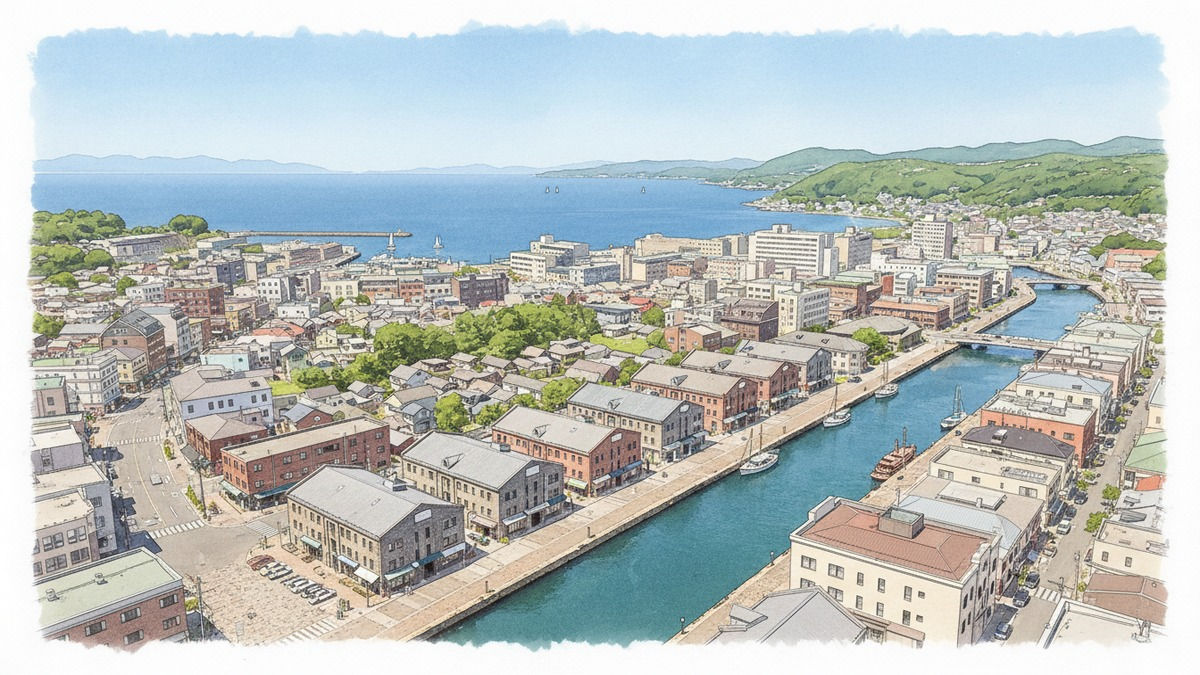
This image was generated by AI for illustrative purposes.
| Area | Distance from JR Otaru Station | On foot | Bus/Car | Suggested time |
|---|---|---|---|---|
| Canal & Chuo Bridge | About 600m | About 7–10 min | — | 1.5–2 hours |
| Sakaimachi Street | About 1.4km (from the station) | About 18–20 min | — | 1–2 hours |
| Temiya & North Canal | About 1km (from the canal) | About 12–15 min | — | 1–1.5 hours |
| Shukutsu | About 3.8km | Not walkable | Bus about 20 min, car about 10 min | 2–3 hours |
| Asarigawa Onsen | About 8km | Not walkable | Car about 20 min, bus about 40 min | Half a day to an overnight stay |
Travel times vary with tourist-season crowds and snow. We recommend leaving some slack in your plans.
Area 1: Otaru Canal & Chuo Bridge
This is the starting point for sightseeing in Otaru.
Leave JR Otaru Station and walk toward the harbor, and you'll reach Asakusa Bridge in about 7–10 minutes. The walking path from Asakusa Bridge to Chuo Bridge (about 500m) is lined with cobblestones and gas lamps.
The warehouses from the Meiji and Taisho eras are lit up, and the gas lamps stay on from sunset until 4:00 the next morning. The canal area changes character between day and night, and part of its charm is how different it looks depending on the time.
Main spots
- Otaru Canal walking path (Asakusa Bridge to Chuo Bridge)
- Otaru Art Base (former Takahashi Warehouse, Nitori Museum of Art, etc.)
- Former Bank of Japan Otaru Branch (Museum of Finance)
Many international travelers visit, and there's plenty of signage in English, Chinese and Korean. Most overseas visitors who search for "Otaru canal" start here.
Source: Otaru Tourism Association https://otaru.gr.jp/shop/otarucanal (checked 2026-06-03)
Location of Otaru Canal (Google Maps)
Area 2: Sakaimachi Street Shopping Street
A fun area for shopping and street food.
It's about 5 minutes' walk southeast of Otaru Canal (Chuo Bridge) and about 3 minutes' walk from JR Minami-Otaru Station. Sakaimachi Street Shopping Street stretches for about 900m, lined with shops in Western-style buildings from the Meiji and Taisho eras.
Main spots
- Kitaichi Glass (glass crafts and café)
- Otaru Music Box Museum
- LeTAO Main Store (Western-style sweets)
- Sakaimachi Street Shopping Street (about 900m)
In summer (July to early September), the street holds a Japanese umbrella light-up (sunset to 22:30), offering a unique view of Western-style buildings through Japanese paper umbrellas. Source: Otaru Sakaimachi Shopping Street official site https://otaru-sakaimachi.com/ (checked 2026-06-03)
If you're starting from Minami-Otaru Station, it's also easy to take the reverse route, starting at Sakaimachi Street and walking to the canal.
Location of Sakaimachi Street Shopping Street (Google Maps)
Area 3: Temiya Area (Former Temiya Line & North Canal)
An area where you can enjoy railway heritage and a quiet stretch of canal.
It's 10–15 minutes' walk from Otaru Station and about 10 minutes' walk from Asakusa Bridge on the canal. There are fewer tourists here, and it still has a local feel.
Main spots
- Former Temiya Line walking path (a Meiji-era disused railway, part of the Japan Heritage "Coal, Steel and Port" story)
- Otaru Museum (Main Building): displays real steam locomotives, a turntable and more
- North Canal walking path: quieter and calmer than the canal in the commercial area
Source: Otaru Museum https://www.city.otaru.lg.jp/docs/2020100900923/ (checked 2026-06-03)
Walking along the old Temiya Line tracks to the museum is especially recommended if you're interested in history. During the Otaru Snow Light Path festival in February, the Former Temiya Line venue is decorated with magical snow candles.
Location of the Former Temiya Line walking path (Google Maps)
Area 4: Shukutsu Area
An area where you can feel the sea and the history of herring fishing.
It's about 3.8km from JR Otaru Station and the canal area, roughly 20 minutes by bus or 10 minutes by car. You can take Hokkaido Chuo Bus's "Otaru Aquarium Line," but services are limited. Check the timetable before you set off.
Main spots
- Otaru Aquarium (check the official website for the latest hours and prices)
- Otaru Herring Mansion: a historic building that tells of the prosperity of Meiji-era herring fishing
- Shukutsu Panorama Observatory: a spot with sweeping views of the coastline and Ishikari Bay
Source: Otaru City official site https://www.city.otaru.lg.jp/categories/bunya/kanko/map/map/ (checked 2026-06-03)
Since it's far from the center, we recommend setting aside at least half a day if you visit Shukutsu. Combining the aquarium and the observatory takes 2–3 hours.
Location of the Shukutsu area (Google Maps)
Area 5: Asari & Asarigawa Onsen Area
A stay-oriented area for visitors who come for hot springs and relaxation.
Asarigawa Onsen is about 20 minutes by car from JR Otaru Station, or about 10–15 minutes on foot or by bus from JR Asari Station. Rather than sightseeing spots, it's rich in "stay-style" experiences, such as soaking away your fatigue in a hot spring at the end of a day in Otaru.
Main spots
- Asarigawa Onsen (hot spring facilities such as Yunohana Asaridono and Asari Classe Hotel)
- In winter, a ski area (Asarigawa Onsen Ski Area) is right next door
Source: Asarigawa Onsen https://www.visit-hokkaido.jp/spa/spot/detail_10612.html (checked 2026-06-03)
Details on Asarigawa Onsen's day-use hot spring facilities are in our Otaru Day-Trip Onsen and Drop-In Bath Guide.
Location of the Asarigawa Onsen area (Google Maps)
How to Get a Sightseeing Map
Here's how to get a map you can actually use on the ground.
Printable PDF Maps (Work Offline)
Otaru City and the Otaru Tourism Association publish printable sightseeing maps as PDFs. Download and print them in advance, and you'll be fine even without Wi-Fi.
- Otaru City sightseeing map (printable PDF): https://www.city.otaru.lg.jp/categories/bunya/kanko/map/map/
- Otaru Tourism Association guide map list: https://otaru.gr.jp/guide_map
- Japanese-English course maps (courses recommended by Otaru guides): https://www.city.otaru.lg.jp/docs/2020100900923/
Pick One Up Locally
The Otaru International Information Center inside JR Otaru Station (9:00–20:00) hands out a range of maps for free. Multilingual maps are available, including Japanese, English, Chinese and Korean.
Smartphone Apps (Offline Use)
- Google Maps: Download the area in advance to use it offline
- Maps.me (MAPS.ME): Free offline maps
Download them before you leave and you won't need to worry about Wi-Fi on the ground.
Summary: Get a Feel for the Distances First
To enjoy Otaru efficiently, it's important to get a sense of the distances between areas at the start.
- Canal to Sakaimachi Street: Just 5 minutes apart on foot, so you can see them together
- Temiya Area: Walkable from the canal, but allow plenty of time
- Shukutsu: A bus is a must. Set aside at least half a day
- Asarigawa Onsen: Perfect for ending your sightseeing with a hot spring soak
For details on transportation and getting around Otaru, see our Otaru Transportation Guide. We also introduce a one-day model course for Otaru in Otaru Half-Day Model Course.