Otaru Anime and Manga Pilgrimage Guide | Walking Golden Kamuy and Saikano
・
If you are going on an anime and manga pilgrimage in Otaru, it helps to first separate "places that are easy to confirm through official or semi-official sources" from "places fans love as models for the setting" — that way you are less likely to get confused on site. This article focuses on Golden Kamuy and Saikano (Saishu Heiki Kanojo), and lays out a central course you can walk in half a day and a full-day course that adds hills and a lookout.
Separate the evidence when doing an anime and manga pilgrimage in Otaru
Otaru is a town where the port, canal, historic buildings, hills and lookouts are all close together. Walking around with anime and manga as your starting point, you see not only the atmosphere of the works but also the history of the town as a thriving port, and the terrain typical of a town of hills.
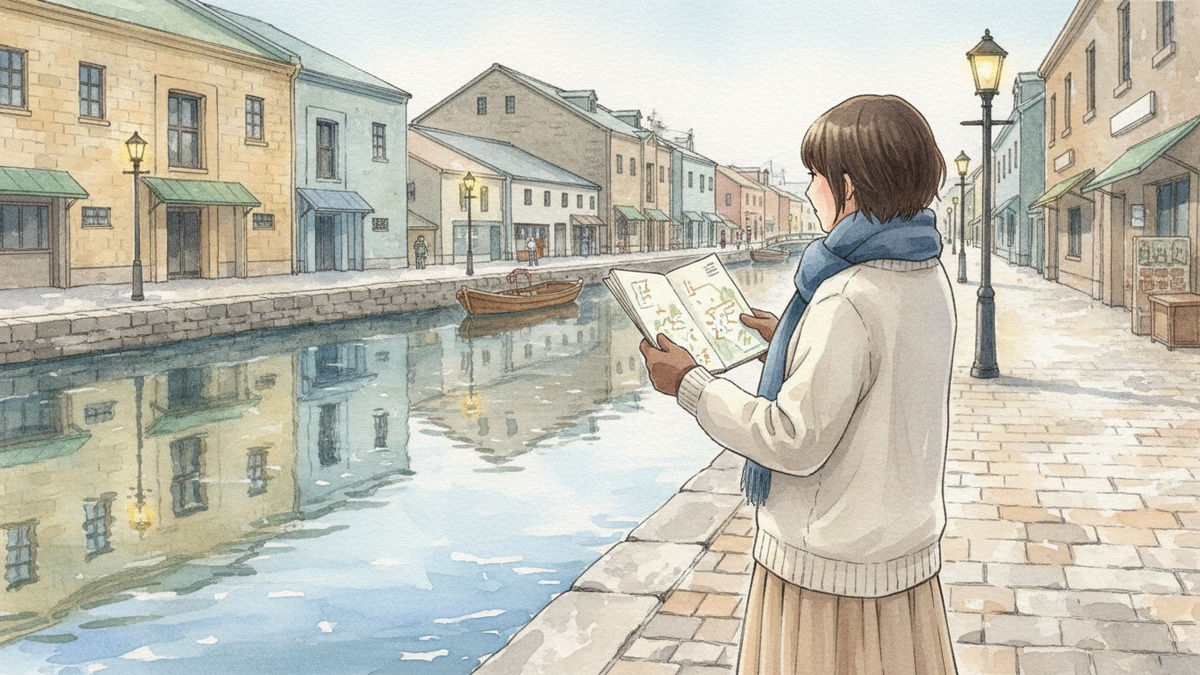
This image was generated by AI for illustrative purposes.
However, it is risky to call every spot an "official pilgrimage site" with the same certainty. This article introduces them in the following 3 levels.
| Strength of evidence | How this article treats it | Example |
|---|---|---|
| Strong direct evidence | Especially easy to treat as a place connected to the work | The former Nippon Yusen Otaru Branch and Golden Kamuy |
| Official facilities and historical background | Easy to walk as background for understanding the work | Otaru Canal, the former Aoyama Villa, Otaru Museum |
| Secondary information and fan pilgrimages | Treated with care as places said to be models | Asahi Observatory, Jigoku-zaka and Saikano |
If you want an overview of film and anime pilgrimages across Otaru, start with the parent article, Otaru Film and Anime Pilgrimage Map: The Complete Guide, to get the big picture. If you only want to look across films, go to Otaru Movie Locations Guide.
The 2 to read first: Golden Kamuy and Saikano
At present, the two works to cover first for an anime and manga pilgrimage in Otaru are Golden Kamuy and Saikano. The former pairs well with historic buildings and modern Hokkaido history, while the latter connects to distinctly Otaru scenery: hills, lookouts and a snowy town.
| Work | How to see it in Otaru | Article to read first |
|---|---|---|
| Golden Kamuy | Focus on the former Nippon Yusen Otaru Branch, the canal, historic buildings and herring culture | Golden Kamuy Otaru Pilgrimage |
| Saikano | View Asahi Observatory, Jigoku-zaka and the Otaru Station area carefully as "setting models" | Saikano Otaru Pilgrimage |
For Golden Kamuy, the former Nippon Yusen Otaru Branch is the easiest entry point. It is listed in Anime Tourism's pilgrimage database, and the building's history, location and visiting conditions can be confirmed through the facility's official information and the Otaru Tourism Association. Rather than aiming only to recreate the work, walking it as a history stroll to learn about Hokkaido in the Meiji and Taisho eras will deepen your understanding.
Saikano, on the other hand, is less about official filming locations and more a pilgrimage of walking places said to be models for the setting. Asahi Observatory and Jigoku-zaka have long been loved by fans, but this article does not state that they are "officially recognized". The premise is to cherish your feelings for the work while putting safety on the hills and residential streets first.
Half-day central course
For your first anime and manga pilgrimage in Otaru, a half-day course built around the central area only is the safe choice. Linking Otaru Station, Ironai, the former Nippon Yusen Otaru Branch and the Otaru Canal is manageable on foot and lets you enjoy both the background of the works and sightseeing.
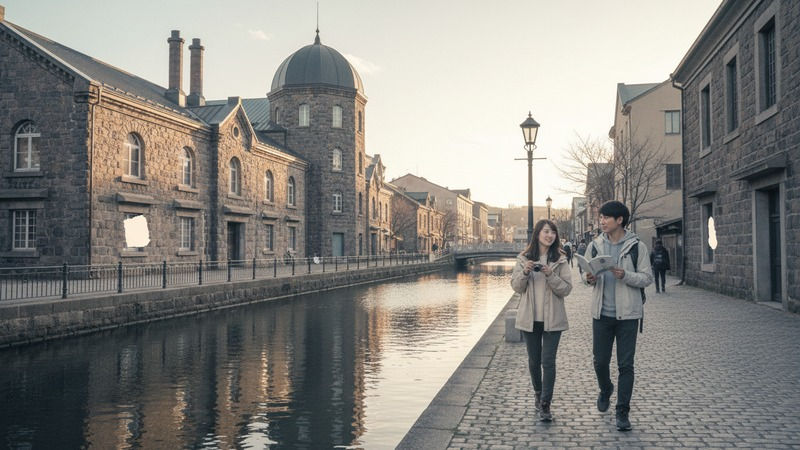
This image was generated by AI for illustrative purposes.
| Order | Spot | How to see it | Approx. time |
|---|---|---|---|
| 1 | JR Otaru Station | Starting point of the pilgrimage. Check your luggage and return train times | 10 min |
| 2 | Ironai-odori | Walk it as a street lined with modern architecture | 20–30 min |
| 3 | Former Nippon Yusen Otaru Branch | The most important Golden Kamuy-related site | 45–60 min |
| 4 | Otaru Canal | Feel the background of the warehouses and port town | 30–45 min |
| 5 | Toward Sakaimachi Street | Use for breaks, shopping and meals | 60 min+ |
The central area alone takes about 2.5–4 hours. If you are taking photos as you walk, don't stand for long at the edge of the road; take photos in places where you won't block traffic. Inside facilities such as the former Nippon Yusen Otaru Branch, check the on-site guidance on whether photography is allowed and on exhibition room rules.
If you want to link the central area by bicycle, Half-Day Model Course: Cycling Otaru's Filming Locations is also helpful. However, around Sakaimachi Street and on crowded sidewalks, it is safer to plan on walking your bike and parking it.
Full-day course with hills and a lookout
If you want to fully take in the atmosphere of Saikano, treat Asahi Observatory and Jigoku-zaka as a separate block. They are within walking distance of Otaru Station, but the hills are long, and in winter or on rainy days they are much more demanding.
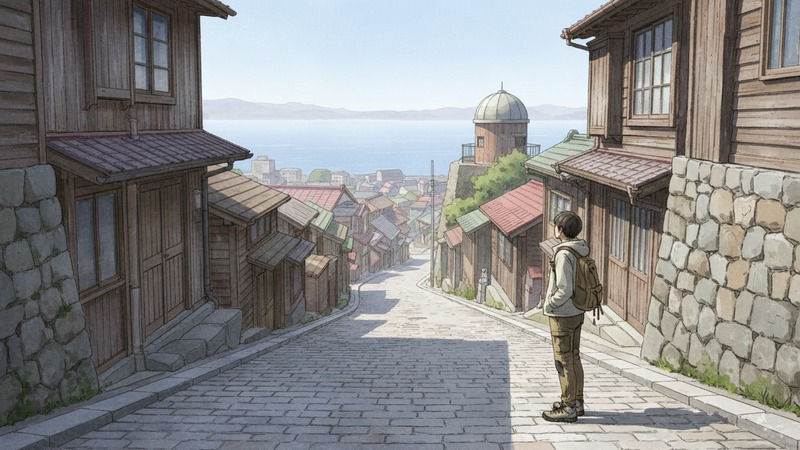
This image was generated by AI for illustrative purposes.
When adding the hills, plan your energy separately from the central-area walk.
| Course | Suits | Notes |
|---|---|---|
| Central area only | First-timers, short visits, uncertain weather | Less depth on the background of the works |
| Central area + foot of Jigoku-zaka | Those who want a taste of the hills | Watch for ice in winter |
| Central area + Asahi Observatory | Those with stamina who can spend time during the day | Check road closures, snow and a safe way back |
Asahi Observatory is a lookout with views over central Otaru and Ishikari Bay. The view on a clear day is wonderful, but it is best to avoid going alone at night or in winter. In winter, road closures and snow conditions make it a completely different level of difficulty from the regular season.
Jigoku-zaka ("Hell Hill") is, as the name suggests, a steep hill. Even if you want to feel the atmosphere of the work, be ready to turn back partway. A pilgrimage is less about "recreating the work perfectly" and more about walking with respect for present-day Otaru's residential streets and facility rules.
Works under consideration for future research
We plan to keep expanding the range of works covered in Otaru's anime and manga articles. However, before giving any work its own article, the evidence needs to be organized through official and semi-official sources and on-site checks.
| Candidate | Current status | Notes |
|---|---|---|
| Cross-cutting guide to Otaru anime and manga | This article | Entry point to the 2 published articles |
| Monogatari series | Research candidate | Need to confirm the basis for treating it as a model location |
| Other manga and anime works | Research candidate | Excluded if the link to Otaru is weak |
Even when adding candidates, we put priority on making it clear what readers searching by title can actually see on site. We avoid stating things as fact based only on fan information, and avoid guidance that could cause trouble for local facilities.
Things to note before your pilgrimage
On an anime or manga pilgrimage, part of the fun is overlaying memories of the work onto the real scenery. On the other hand, many of Otaru's spots are tourist facilities, working roads, residential areas and businesses that are open.
- Don't hold up screenshots or character images prominently for photos on site
- Follow on-site rules on whether photography is allowed inside facilities
- Don't stand still for long in residential areas or on hills
- In winter, assume non-slip shoes and moving around during daylight hours
- Don't confuse "official pilgrimage sites" with "model locations"
On the hills and the lookout side in particular, how it feels varies greatly with the weather and footing. Even if places look close on Google Maps, there are real differences in elevation, so allow plenty of time and energy.
Related reading
- Otaru Film and Anime Pilgrimage Map: The Complete Guide — the parent article for those who want to look across films, dramas and anime.
- Golden Kamuy Otaru Pilgrimage — a closer look centered on the former Nippon Yusen Otaru Branch and modern Hokkaido history.
- Saikano Otaru Pilgrimage — points to note when walking Asahi Observatory and Jigoku-zaka.
- Half-Day Model Course: Cycling Otaru's Filming Locations — how to cover filming locations in the central area efficiently.
- Otaru Movie Locations Guide — for those who want to look across films only.
Access and map
The starting point for the central area is JR Otaru Station. The former Nippon Yusen Otaru Branch and the Otaru Canal area can be covered on foot, but the way to Asahi Observatory is uphill, so decide based on the weather and your stamina.
Location of JR Otaru Station (Google Maps)
Location of the former Nippon Yusen Otaru Branch (Google Maps)
Location of Asahi Observatory (Google Maps)
FAQ
Which article should I read first for an anime and manga pilgrimage in Otaru?
For the big picture, read the parent article; if you only want anime and manga, read this article; and for a deeper look at each work, the Golden Kamuy and Saikano articles are the easiest to follow.
What is the easiest place to visit on a Golden Kamuy pilgrimage in Otaru?
The former Nippon Yusen Otaru Branch is the easiest site to work with. It is listed in Anime Tourism's pilgrimage database, and the building's history and visiting conditions can be confirmed in the facility's official information. Check opening hours, closing days and photography rules on the official site before you visit.
Are the Saikano spots in Otaru official filming locations?
This article does not call them "official locations"; it treats them as "places said to be models for the setting" and "places fans love as pilgrimage sites". Asahi Observatory and Jigoku-zaka are mentioned in many pilgrimage sources, but we use wording that does not state they are officially recognized.
Can I cover both Golden Kamuy and Saikano in half a day?
You can fit the former Nippon Yusen Otaru Branch and canal area in the center plus the foot of Jigoku-zaka into half a day. However, walking up to Asahi Observatory involves a long hill and takes more than half a day including breaks. Rather than cramming it in, it is safer to split the central course and the hill course.
Can I do the pilgrimage in winter?
The Otaru Canal and central area can be walked year-round, but Jigoku-zaka and the way to Asahi Observatory become harder with snow and ice. In winter, assume non-slip shoes, gloves and moving during daylight, and check road closures to Asahi Observatory and traffic conditions in advance.
Summary: balance your love for the works with consideration for the place
An anime and manga pilgrimage in Otaru is easier when you separate the context of Golden Kamuy — historic buildings and the port town — from that of Saikano — hills, a lookout and a snowy town. Not declaring everything an official pilgrimage site, and touring while keeping the strength of the evidence in mind, is a way of enjoying it that is honest to both the works and the place.
Start by walking the former Nippon Yusen Otaru Branch and the Otaru Canal in the center, and if you have time and energy to spare, extend to Asahi Observatory and Jigoku-zaka. If you are covering several works, reading the parent article and the individual work articles first will make it easier to plan your day.